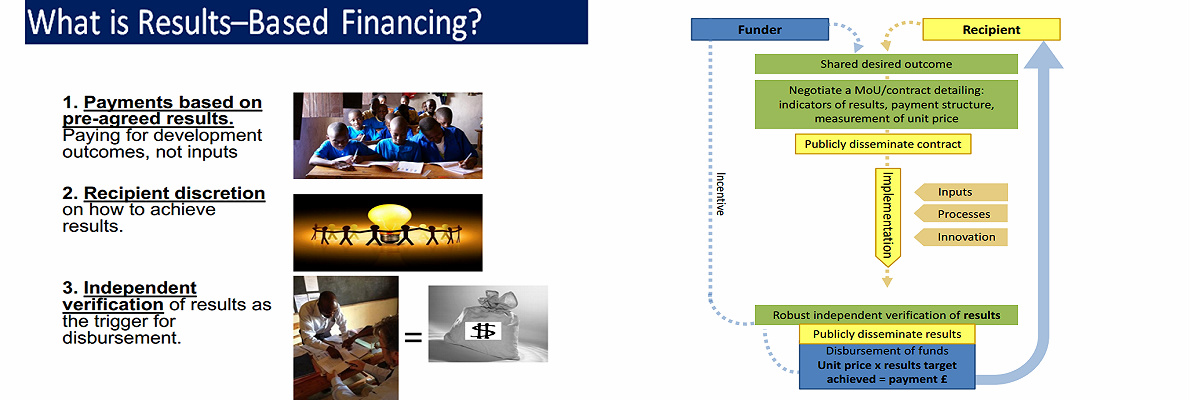
The Community SWEEP Programme conceptualization of Results-based financing (RBF) of service delivery, includes performance-based incentive awards,
performance(output)-based financing, use of payment vouchers–all of which tie payments to results rather than payment for inputs.
The Community SWEEP RBF -whether supply-side or demand driven model not only shifts away from directly funding inputs, towards paying directly for outcomes, but also places a responsibility on the service
provider to both design an efficient and cost effective results achieving model, subject to an independent verification of results before payment is made .
Together with resource-supporting Ugandan and International partners, the Community SWEEP Programme will from time to time identify and fund innovative Results-Based Financed (RBF) ideas that aim at
practically achieving more than a quarter(25%) of 17 Community SWEEP Mission (UN goals).
View samples of the Community SWEEP desired RBF service delivery programs for support and subject matter guiding references .
Sample#1: Ugandan Agri-business Private Sector Enhancement of Household Agriculture,
Nutrition, Risk Reduction and Community Empowerment (ENHANCE) project via Results-Based-Financing (RBF) Project in the Drought Stricken Regions of Northern
Uganda.
Comments on Sample#1: The above RBF sample idea supports(1) the Community SWEEP mission (addresses six UN goals ) of
Poverty, Health, Education, and Gender Equality, Employment, and Climate change mitigation and (2) the Community SWEEP Approach of integrated–service delivery
via the Ugandan Agri-business private sector as a one-stop center, and reflect some innovation, objectivity, private sector cost share, measurable results,
sustainability of effort , and growth potential .
Sample#2:Enhancing Non Formal Education for Marginalized Girl’s Increased Enrollment (ENGINE)”
via faith based organizations (FBOs) networks through “Results-Based Financing” (RBF) model in Rural Uganda .
Comments on Sample#2:The above RBF sample idea supports (1) the Community SWEEP (addresses five UN goals) of Poverty, Health,
Education, Gender Equality, and Employment; and (2) the Community SWEEP Approach of integrated–service delivery via
Faith based Organizations (FBOs) networks as a one-stop center.